
An Open Letter, A National Movement
FROM THE VILLA TO THE VILLAGE
The Student Movement Asking Nigeria’s Lawmakers to Let Data — Not Guesswork — Govern
An Open Letter to the National Assembly, and the Story Behind It
By the Office of the Global Nigeria Student Ambassador, Dr. John Aikeremiokha, in partnership with Nuhu Aminu Nuhu, President, National Association of Nigerian Students in Diaspora (NANSA)
IT BEGAN AT THE VILLA
Every movement needs a moment it can point back to — a moment where an idea stopped being a conversation and became a mandate. For this one, that moment came at the Presidential Villa in Abuja, when the initiative was formally launched in the presence of Nigeria’s First Lady, Senator Oluremi Tinubu.
It was, in one sense, a simple gathering. In another, it was a signal: that the question of how Nigeria collects, protects, and uses data to govern itself had reached the highest room in the country. The message delivered that day was not one of protest — it was one of partnership. Nigerian students, at home and abroad, were not there to criticise government from the outside. They were there to offer to build, alongside it, the data infrastructure the country has needed for a generation.
THE WORLD WAS LISTENING: A RELAUNCH AT THE UNITED NATIONS
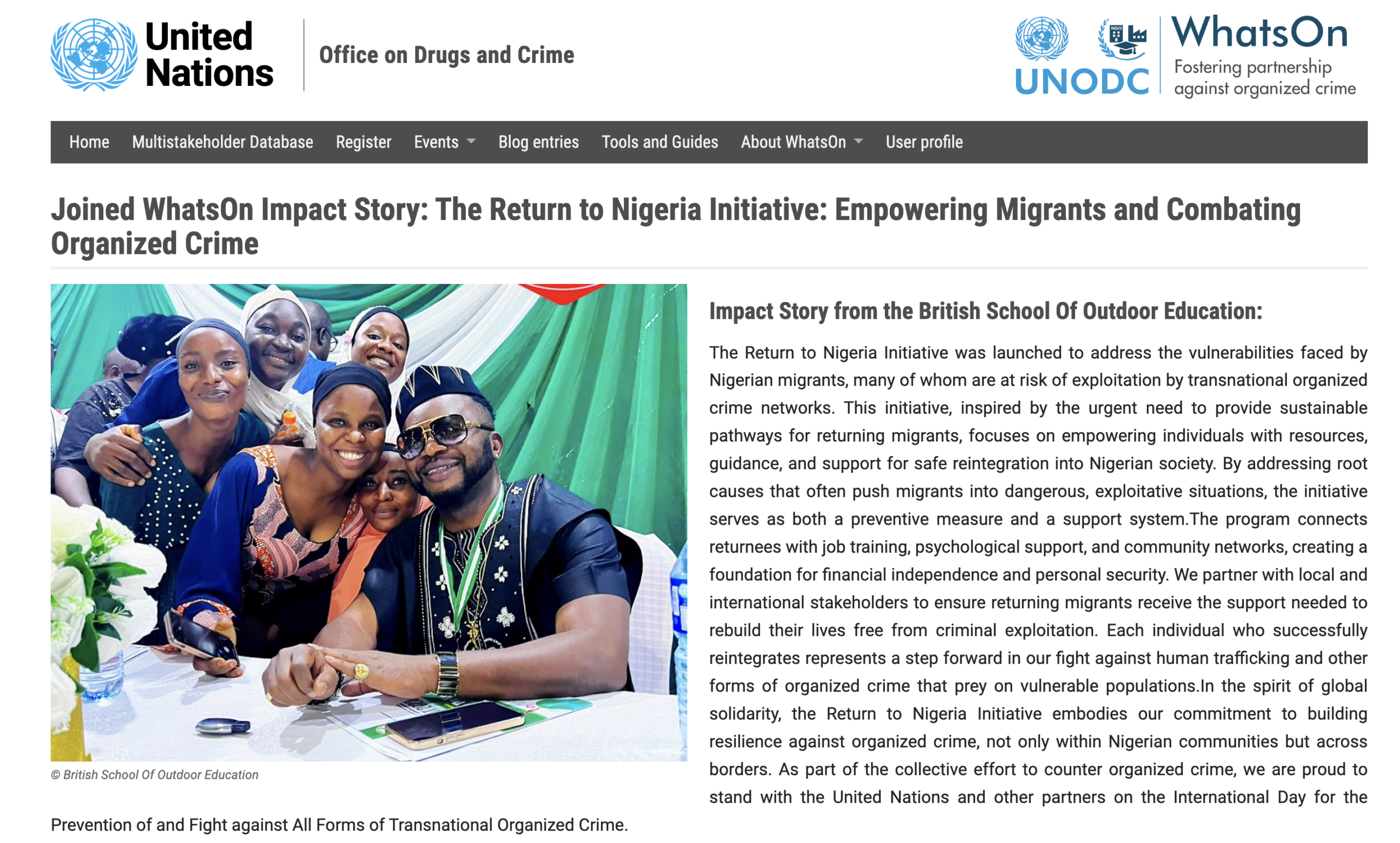
What started in Abuja did not stay in Abuja. The initiative was relaunched before the world, published as an official impact story on the United Nations Office on Drugs and Crime (UNODC) platform, under the title ‘The Return to Nigeria Initiative: Empowering Migrants and Combating Organized Crime’ — recognised as part of the first International Day for the Prevention of and Fight Against All Forms of Transnational Organized Crime.
That recognition matters because the initiative was never only about dashboards and data. At its heart is a harder truth: too many Nigerians who leave home in search of a better life are met instead by exploitation — trafficked, deceived, and preyed upon by transnational criminal networks that thrive precisely where governments have no visibility and no data on the people most at risk.
The Return to Nigeria Initiative was built to interrupt that cycle, connecting returning migrants with job training, psychological support, and community networks that restore not just their safety, but their independence and dignity. For the United Nations to platform a Nigerian student-led initiative on this global stage is rare. It is a signal that what began as a domestic call for data-driven governance has become something larger: a recognised front line in the fight against human trafficking and organized crime, and proof that Nigerian students can lead credible, internationally validated reform — not only for the country, but for its most vulnerable citizens abroad.
BRINGING GOVERNMENT HOME: THE LOCAL GOVERNMENT CHAIRMEN
This is why the initiative’s next major front, to be facilitated by the Association of Local Governments of Nigeria (ALGON), will be a direct engagement of Local Government Chairmen across the federation — to drive grassroots engagement and development through trained, data-equipped young Nigerians embedded at the level of government closest to the people.
Nigeria’s governance failures are rarely only a federal problem — they compound hardest at the state and local level, where budgets are smallest, oversight is thinnest, and the system is most exposed to mismanagement. By bringing ALGON and every local government chairman into this initiative directly, the movement ensures that data-driven accountability does not stop at the federal gate. It reaches the ward, the village, the community — where government is felt first, and trusted last.
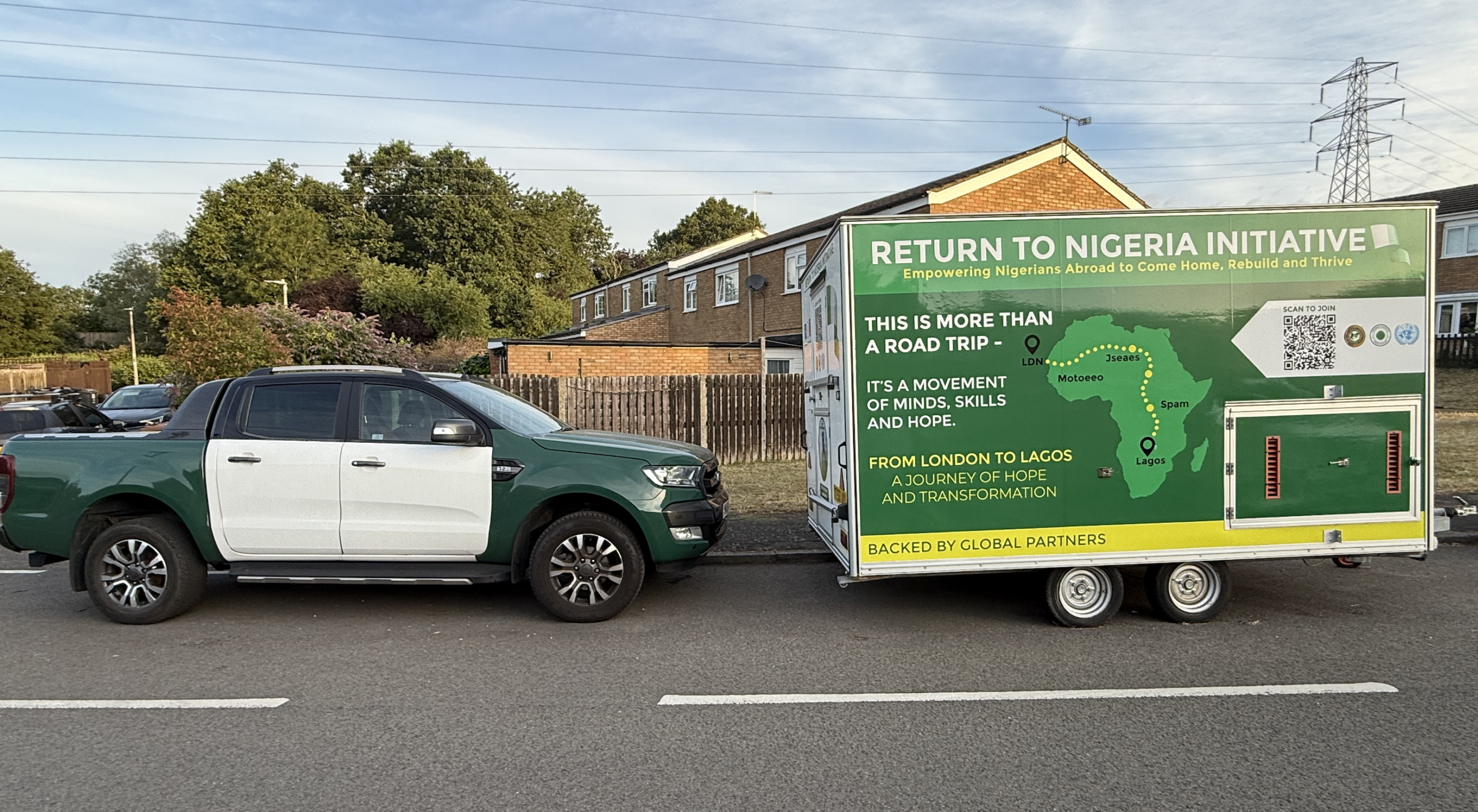
6,200 MILES OF ADVOCACY: LONDON TO LAGOS
If the Villa launch was the initiative’s declaration, the road from London to Lagos has been its proof of commitment. Dr. John Aikeremiokha, the Global Nigeria Student Ambassador, undertook a transcontinental overland journey — over 6,200 miles, through eight countries — to carry the initiative’s message directly to the diaspora and to Nigeria’s diplomatic network abroad.
The journey was not symbolic alone. It was diplomatically anchored: mandated by Nigeria’s Foreign Ministry, the Ambassador received engagement and support from 17 Nigerian foreign missions along the route, each one reinforcing the same message — that the diaspora is not a distant stakeholder in Nigeria’s future, but a direct participant in it. The journey began, fittingly, at the Nigeria High Commission in London — the diaspora’s first and most visible point of contact with home — where the Ambassador departed with the backing of Nigeria’s diplomatic corps abroad.

WHY THIS MATTERS NOW
None of this — the Villa, the United Nations, ALGON, the 6,200-mile journey — was undertaken for ceremony. Every stage has built toward a single, practical demand: that Nigeria’s federal agencies, ministries, governors, and local governments begin making decisions based on verified data, not guesswork, and that Nigerian students be the generation trained, certified, and trusted to build that data infrastructure.
For years, public discontent with governance in Nigeria has grown — not from a dislike of the country, but from frustration with decisions made without evidence, resources managed without accountability, and a system left vulnerable to corruption. This initiative was built as a constructive answer to that frustration.
The Office of the Global Nigeria Student Ambassador is already running the training — certifying Nigerian students as data analysts, engineers, and scientists to work directly with government agencies, feed verified data into Nigeria’s blockchain infrastructure, and put real-time, evidence-based dashboards in front of every minister, governor, and local government chairman making decisions on the nation’s behalf. Full details of the training framework, and what we are formally asking of government, are set out in the letter published alongside this feature.
THE LETTER TO THE NATIONAL ASSEMBLY
It is against this backdrop — a Villa launch, a UN relaunch, a nationwide local government engagement, and a diaspora journey spanning a continent — that the Office of the Global Nigeria Student Ambassador, Dr. John Aikeremiokha, together with NANS and NANSA President Nuhu Aminu Nuhu, has now written formally to the President of the Senate and the Speaker of the House of Representatives, requesting an audience before both chambers of the National Assembly.
The letter, published in full alongside this feature, asks for the opportunity to present the initiative’s training and certification framework, to discuss the legislative and policy support needed for government agencies to absorb trained graduates, and to explore how this initiative aligns with Nigeria’s ongoing blockchain and digital governance strategy. It is, at its core, an offer rather than a demand: a generation of Nigerian students, trained and ready, asking not for a favour, but for the chance to build alongside the leaders who govern them.
THE NATION IS WATCHING. WILL THE ASSEMBLY ANSWER?
A country does not run out of talent. It runs out of patience. Every year, Nigerians watch resources vanish into decisions no one can trace, and watch their brightest sons and daughters leave in search of a system that will finally use them. Some never make it — swallowed instead by the same traffickers and criminal networks this initiative was built to fight.
This movement has stood in the Presidential Villa. It has been recognised by the United Nations. It will soon reach every local government chairman in the federation through ALGON. It has crossed eight countries and 6,200 miles on the strength of its own conviction. It is no longer a request whispered from the margins — it is a mandate carried home by the very students the nation was afraid of losing.
The only question left is not whether Nigeria has the talent to fix what is broken. It already does. The question is whether the National Assembly will open its doors before this generation stops asking — and starts building somewhere else. The Office of the Global Nigeria Student Ambassador, Dr. John Aikeremiokha, and the National Association of Nigerian Students in Diaspora, under President Nuhu Aminu Nuhu, are waiting for an answer. So is the country.
Take the Next Step
Read the published letter alongside this feature and follow the movement as it calls for data-driven governance, student-led reform, and accountable national leadership.